

Pakistan
Land of the Indus, the Cradle of Civilisation - February 2025

This adventure in Pakistan was originally planned to take place back in 2017, but unforeseen events at the time meant that it had to be prorogued. Fast forward eight years to 2025 and the long wait would be rewarded with a trip that would far exceed any preconceived expectations.
As a holiday destination Pakistan is definitely an off the radar target, and would barely register on most peoples must see list, its negative media persona shedding the most unsavoury light on any thoughts of a potential visit. Look behind this veil and there is a country that offers amazing architecture, a cultural history to rival that of ancient Egypt and Mesopotamia, friendly people and a world class cuisine – in fact everything its illustrious neighbour India has to offer the curious traveller, except the ubiquitous hordes of tourists.
When he saw the breadth of his domain Alexander wept, for there were no more worlds to conquer - Attributed to Alexander the Great (356- 323 BC).

A Brief History
The defined borders of the country we know today as Pakistan are a quite recent incarnation, formed as a result of the atrophy of the British Raj and the partition of the Indian subcontinent in 1947, culminating in Pakistan’s subsequent declaration of independence. Prior to that date the country we identify as modern Pakistan consisted of a number of semi-autonomous states that were part of the greater Indian subcontinent.
The gigantic Faisal Mosque is visible from everywhere in the Islamabad cityscape
The seminal averment of human settlement in the area dates back to around 8000 BC, with evidence of agriculture and the domestication of animals implemented as the climate grew warmer. From around 3000 BC what we perceive as the Indus Valley Civilisation flourished for around 1500 years. A sophisticated society, they constructed cities at Harappa and Moenjo Daro located in close proximity to the flood plains of the Indus River system. The influence of this progressive civilisation was abruptly expunged circa 1500 BC with the invasion by the Aryan hordes emanating from Central Asia.
With the gradual atrophy of Aryan regional dominion, and a succession of weak rulers unable to sustain a unifying governing force, Pakistan lingered in a lacuna induced power vacuum up until the 6th century BC; vulnerable to invasion, it came under the demesne of the expanding truculent Persia Empire of Cyrus the Great in 530 BC.
The next major incursion into the region saw the arrival in 327 BC of the Macedonian empire builder Alexander the Great, who terminated Persian territorial hegemony defeating Darius III. Alexander’s sojourn though the province was ephemeral, and by 323 BC he had left Pakistani soil on his way back to Macedonia, although he would die before reaching there.
The Mauryan Empire was the next power broker in the region, eventually conquering most of the entire subcontinent by the year 260 BC under their most successful leader Asoka. The Mauryan Empire rapidly disintegrated after the death of Asoka, and by 185 BC the Bactrian king Demetrius had brought most of what encompasses the borders of modern Pakistan under his fiefdom.
The year 711 AD saw the bellicose Arab army under General Mohammad Bin Qasim rampage across the region, instituting a series of Muslim dynasties that would rule the dominion for several hundred years, bringing with it a tide of Islam that would engulf its territorial sphere of influence. The end of the 10th century saw the arrival of the belligerent Turks into the imperial arena, ushering in the nascent beginnings of the Ottoman Empire that would encompass the domain, and ultimately extend as far west as the gates of Vienna.
In 1221 the bellicose Mongol hoards under Genghis Khan laid waste to the region, to be followed in 1398 by the truculent Central Asian conqueror Timur, who visited death, destruction and perdition upon the subcontinent. The beginning of the 16th century saw the arrival of the Moghul adventurer Babur, a descendent of the house of Timur. This period of occupation by a series of Moghul rulers saw the ultimate flowering of art, architecture and culture that has deposited a magnificent legacy that perdures to the present day. Babur’s descendant Shah Jahan - reigned 1627-58 - would go down in history as the architect of the majestic Taj Mahal.
The nadir and collapse of the Moghul Empire, and the arrival of the British in the mid-19th century was to change the region forever, the Indian subcontinent becoming the jewel in the crown of the expansive British Empire that was at the zenith of its power.
The year 1947 was a seminal moment in the history of the subcontinent as British India was partitioned, and the modern country of Pakistan came into existence, Muhammad Ali Jinnah becoming the country’s first president. Pakistan’s post- independence history has been plagued by internal and external conflict; periods of democratic rule and periods of military dictatorship litter the political landscape. Several wars have been fought against India over the disputed region of Kashmir, a precarious standoff between two nuclear armed nations. Down the years Pakistan has additionally endured its fair share of political assassinations, suicide bombings, rampant corruption, scandals and negative media coverage, it has been a rocky road travelled in the post-independence years.
The Journey
This eagerly anticipated adventure commences with a six-and-a-half-hour flight to Doha, followed by a two-and-a-half-hour flight to Pakistan’s capital Islamabad. Like a number of trips I have undertaken recently, Pakistan retains some of the influences from the country’s British colonial past – driving on the left side, 3 pin power plugs and the ubiquitous use of the English language.
The first day of this journey was a hedonistic treat, a swim in the hotel’s heated outdoor rooftop pool, relaxing whilst topping up my suntan, a therapeutic hot oil massage and rounding the day off with a session in a sauna.
Pakistan’s history has been greatly influenced by its geographical location, it is surrounded by China, Iran, Afghanistan and India, it has hostile relations with all of them. Pakistan’s fledgling tourism industry is in its infancy; this translates on the ground to the government being extremely cautious over the safety of its foreign visitors. Many of the hotels frequented had barbed wire barricades and armed guards at the entrances, additionally much of our time on the road, and around the numerous archaeological sites visited, we were escorted by a convoy of police armed with AK47’s. There are several schools of thought with regards to this situation; is Pakistan that dangerous that this overt security is necessary, is this being over cautious, or is this the governments palliative measure, realising that the smallest of unfortunate incidents involving a tourist group could kill Pakistan’s nascent tourism industry stone dead. With hindsight I tend to defer to the latter.

An elderly gentleman takes a tea break
Islamabad is constructed on a grid system; its wide roads make driving around somewhat more manageable than many of the other cities that would be subsequently visited. The initial stop today is the Golra Sharif Railway Museum, for a railway enthusiast like myself this was a fantastic attraction. Housed in a handsome sandstone building, the museum is a repository full of antiquated railway paraphernalia including clocks, tools, signalling equipment, crockery, lamps, timetables and wonderfully evocative old black and white photographs from eras that have long passed into history. The absolute highlight of the museum’s collection were three preserved steam locomotives and some rolling stock; one beautifully renovated wood panelled carriage was the personal mode of travel for Lord Mountbatten, who was the last viceroy of British India.
A brisk walk up to the Daman-e-koh viewpoint is rewarded with a breathtaking panorama of the whole cityscape, supplemented by a spectacular backdrop of brooding mountains. Dominating the city skyline is the egregious Faisal Mosque – one of the biggest in the world – designed by the Turkish architect Vadat Dalokay, its sweeping geometric roofs are constructed so as to resemble an indigenous desert tent, whilst the soaring pencil minarets are reminiscent of space rockets. The vast interior can accommodate 15,000 worshipers, the mosque complex additionally houses a museum, a research centre, a university, and various other notable didactic facilities.
The innumerable historical and cultural exhibits in Islamabad’s specious Heritage Museum are beautifully presented and annotated. The museum showcases endemic Pakistani objet d’art, statues, pottery, jewellery, music and textile work, alongside dioramas and displays containing information on all the surrounding countries with historical links to Pakistan. There are expositions on China, Uzbekistan, Kazakhstan, Tajikistan, Kyrgyzstan, Turkmenistan and also Iran, all initiating a fascinating and informative visitation experience.
Completed in 2006, the Pakistan Monument symbolises the unity of the Pakistani people, and is dedicated to those who sacrificed “their today for a better tomorrow”. Seven petal shaped structures – derived from the traditional muqarnas of Moghul architecture - converge over a central platform, the monument’s positional elevation makes it visible across the entire Islamabad metropolitan area.
Here in Islamabad, as would become evident elsewhere during this trip, we would be literally the only tourists - a recherche commodity in the modern world of travel -this would propel us to the centre of attention for the locals, who would enthusiastically engage us in conversation and want to take photographs with us.

Pakistan’s roads are awash with vividly painted and extravagantly decorated trucks, so our first stop today was a true gem, a truck workshop where they repair and also decorate these amazingly coloured vehicles. The truck artwork is a mode of expression for the truck drivers, often containing elements that remind them of home, also ornamental décor, calligraphy, poetic verses and paintings. Our stop here brought all work to a standstill as the workshop staff were quite bemused by a group of “crazy” tourists wanting to take photographs.
Two extremely photogenic locals happy to pose for the camera
The Gurdwara Panja Sahib or Temple of the Guru’s Palm is a Sikh shrine located in the small town of Hasan Abdul. The temple site is a tranquil haven, immaculately manicured, it is a photographic delight. The compound features a white-domed temple, a holy water pool, kitchens, and hostels where pilgrims can be accommodated. Gurdwara Panja Sahib is considered one of the most sacred places in the Sikh religion, as it contains the hand print of Guru Nanak the founder of Sikhism.
The UNESCO World Heritage Site of Taxila is the largest and most important archaeological site in Southern Asia. The complex is a sprawling site of three interconnected cities, encompassing well-preserved temples, stupas, shrines and monasteries that date as far back as the 6th century BC. Taxila attained the zenith of its power between the 1st and 5th centuries AD, benefiting economically and culturally from its strategic location on the ancient Silk Road that connected China with the West.
The Dharmarajika Stupa was built in the 3rd century BC to house the relics of the Buddha; the stupa consists of a circular drum standing 14 metres high, and is surrounded by numerous smaller votive stupas. The outstanding Shrine of the Double Headed Eagle is enclosed within a quadrangle, only the base of the stupa now remains, a series of pilasters adorn the base, which are adorned with Corinthian columns and elaborate carvings.
Perhaps the most impressive building at Taxila is the Apsidal Temple, raised on a platform, the temple consists of a porch, a nave, an apse, and is encircled by an ambulatory passage. These are just a few examples of the numerous monuments visited at the site. Primarily the Taxila complex was heavily reconstructed around 15-20 years ago, with many of the structures being rebuilt up to a metre in height, thus giving a nebulous idea of the outline of the various buildings. A furtive imagination is need to visualise how this passe site would have originally looked like.
The on-site Taxila Museum was an extremely interesting and informative experience, documenting the history of the site, and additionally displaying artifacts recovered during its excavation and renovation. Walking in the footsteps of Alexander the Great, who passed through Taxila on his way to ever greater conquests was a truly cerebral experience.
The next stop on this wonderful trip was Rawalpindi, a visit to its bustling Rajah Bazaar is a true assault on the senses, the seemingly chaotic atmosphere is a sensorial overload, and typifies what a visit to a Pakistani city encapsulates.
The UNESCO World Heritage Site of Takht-e-Bahi (Throne of the Water Spring) in Mardan is a well - preserved Buddhist monastic complex. Founded in the 1st century AD the site consists of a main stupa court, a monastery, assembly hall, meditation cells, and numerous votive stupas, its location affords stunning valley panoramas. Takht-e- Bahi is one of the most complete Buddhist monasteries in the region, and was functional until the 7th century. The location and state of preservation of the complex make Takht-e- Bahi an exceptional photographic attraction.
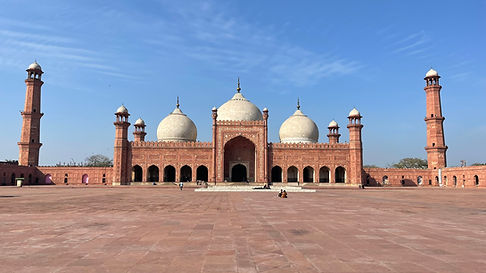
The magnificent Badshahi Mosque in Lahore is the architypal Moghul structure
The journey towards Peshawar is through a fairly flat and featureless agricultural landscape, this is a sojourn into Pakistan’s Northwest Frontier, the Badlands region close the border with Afghanistan, so now we are escorted by fully armed policemen equipped with AK47’s. Peshawar is most definitely a very edgy city, located close to the fabled Khyber Pass which has been an extremely important travel throughfare from time immemorial.
The Peshawar Museum is housed in a wonderful colonial-style building embellished with extravagant cupolas. The museum is a repository for numerous statues of the Buddha, and exquisitely carved friezes depicting various scenes from the Buddha’s life. This museum, like the others visited on this trip, contained exhibits that were beautifully presented and annotated.
Sethi House is a supreme example of late 19th century haveli architecture, showcasing beautiful ornate filigree woodwork, a central courtyard, underground rooms, and decorative features comprising a stylistic synthesis of Central Asian, Persian, and Moghul traditions. Such properties were typically built by individuals of wealth and influence, and their scale and embellishment often signified social stature.
Peshawar’s Bala Hisar Fort is of ancient origin dating back 1,500 years, the fort’s current incarnation dates to the mid-19th century. Situated on a prominent hillock, the fort occupies a commanding and strategic location; it is currently the residence of Pakistan’s Frontier Corps and unfortunately not open to the public.
Gor Khatri is an ancient citadel in the heart of old Peshawar that has been an important staging post for travellers for thousands of years. Originally a Moghul-era caravanserai, where merchants and their retinues engaged in trade and cultural exchange, additionally lodging in lock-up rooms paying a nominal charge for the privilege. Currently it now houses an archaeological museum, excavation site, a temple, and a colonial-era fire station complete with two fire engines of the London Merryweather Company.
Today was a numbingly bone rattling long road journey of 15 hours as we travel from Peshawar towards Lahore. Gridlocked traffic, torrential rain, the main road closed, a detour off road through muddy flooded tracks that resembled a quagmire, then finally up and over a mountain pass.
The journey was ameliorated with a couple of captivating stopovers, the first being the Katas Raj Temple complex, which comprises a collection of seven Hindu temples grouped around a sacred pool that was held to be bottomless. The pool is said to have been formed from a tear which fell from the eye of the Hindu God Shiva who was desolate at the death of his beautiful wife Sati. Featuring distinct Kashmiri-style architecture, the temples are generally in a rather sad and neglected state - a melancholy of fallen splendour - ironically presenting as extremely emotive photographic subjects.
The second stop was the Khewra Salt Mine – the second largest salt mine in the world - comprising an amazingly complex labyrinthine warren of tunnels and chambers that have been mined consistently since Moghul times. Entry into the bowels of the mine is aboard a vintage electric mine train, a journey of 2,000 feet; there are 11 levels below ground and 5 levels above all being worked, excavating the salt goes down to a depth of 11,000 feet. The temperature in the mine is a constant 18 degrees Celsius, the mine employs 1,000 workers with 50% of the salt production being sent for export.

The perfectly symmetrical Mausoleum of Jahangir in Lahore is an absolute delight to photograph
Lahore is Pakistan’s second biggest city with a population of 9 million people. The magnificent Badshahi Mosque, constructed by the Moghul Emperor Aurangzeb in 1674, is a majestic identikit of Moghul-era architecture. The carved red sandstone façade with marble inlay, elegant white marble domes and tapering minarets make it standout as one of the most iconic landmarks of Pakistan. This architectural masterpiece is one of the largest mosques in the world and can accommodate 100,000 worshipers.
Lahore Fort, construction began in 1566, demonstrates the full pantheon of Moghul architectural prowess, occupying a vast area of the old city, it contains 21 structures commissioned by four of the Great Moghul emperors (Akbar, Jahangir, Shah Jahan and Aurangzeb). Amongst the many magnificent buildings within the fort complex, some dazzling examples are; the imposing Alamgiri Gate with high semi-circular bastions and domed cupolas, the elegant Pearl Mosque clad in white marble, its design evidences an architectural nod towards the majestic Moghul masterpiece the Taj Mahal. The magnificent Palace of Mirrors is an artistic master work of beautiful mirror mosaics, and floral patterns comprising semi-precious stones inlaid in marble. Resplendent bijou marble pavilions punctuate expansive green lawns where elephants bearing Moghul emperors once trod. In contrast a few of buildings are sadly passe, and are undergoing renovation works with a subvention from UNESCO, as the fort is a listed site.
Shalimar Gardens were constructed by Shah Jahan in 1641 – dating from the period when the Moghul Empire was at its artistic and cultural zenith – comprising vast lush gardens with royal residences, bijou pavilions, fruit trees, an enormous lake, waterfalls and 410 fountains. This is where Lahore’s citizenry come to relax, promenade in their Sunday best and engage in social intercourse, a peaceful haven from the maelstrom of the city’s chaotic streets.
The final visit of a busy day was an absolute gem, and one of the main reasons for undertaking this trip, the Wagah Flag Lowering Ceremony. This takes place every evening at the border crossing between Pakistan and India, and is one of the greatest spectacles the subcontinent has on offer. There are massive grandstands on both sides of the border, cheer leaders hyping up the crowds, music blaring out, sundry entertainers, and mass flag waving crowds with painted faces, with each side trying to outdo the other in the volume of their support. The border guards are immaculately dressed in ceremonial uniforms, strutting like peacocks, stomping their feet, and goose stepping in synchronicity with the guards of their estranged brother state on the Indian side. The entire event is akin to a highly choreographed war dance, an incredible piece of theatre, culminating with the lowering of the flags, a cross- border handshake and the slamming shut of the border gates.
Lahore is a city wonderfully endowed with a magnificent architectural legacy; the Lahore Museum is a prime totem, being an elegant Moghul-Gothic style building built in 1894. The museum galleries are a repository devoted to Buddhist art, collections from the Moghul Empire, the Sikh Empire, the British Raj, beautiful manuscripts in various Arabic calligraphic styles, and an ethnographic exposition.
Wazir Khan’s Mosque, built in 1634 during the reign of the Emperor Shah Jahan, is a tour de force of Moghul architecture, with florid colourful frescoes and faience tile work that adorns the interior and exterior of the building. The entry portal is decorated with verses from the Quran in elaborate calligraphic script.
Set in beautifully manicured gardens, the Emperor Jahangir’s tomb was built in the mid -17th century, it is an aesthetic piece de resistance in its symmetrically designed proportions. The mausoleum features four 30-metre-tall minarets, frescoes, precious stones inlaid in marble creating elaborate designs, and a red sandstone façade with white marble motifs. At the centre of the mausoleum is an octagonal chamber in which the remains of the Moghul Emperor rest in a crypt positioned beneath a cenotaph.
Another long day on the road travelling from Lahore towards Multan. The journey is broken with a stop at Harappa, an important archaeological site of the Indus Valley Civilisation, and one of the most ancient cities in Pakistan, dating from circa 2600 BC. A fair bit of imagination is needed here, all that is visible are the low foundation walls of the structures that once existed in the heyday of the city. This rather passe site represents a classic archaeological tell site, essentially an artificial mound of detritus created by generations of superimposed mud brick structures.
The onward journey from Harappa to Multan was once again subject to an armed police convoy escort, the security situation in Multan itself was deemed such that we were not permitted to leave the hotel in the evening. Throughout our journey around Multan’s sites we were again accompanied by the local police armed with AK47’s.
Multan contains an agglomeration of handsome examples of pre-Moghul architecture, in particular the tombs of several Sufi saints (Sufism is the mystical and esoteric dimension of Islam based on spiritual purification). The tomb of Sheikh Rukn-e-Alam, completed in 1324, is an especially handsome paradigm; a beautiful building with an octagonal drum footprint topped with a round dome, the exterior red brick walls are ornamented with azure navy and white faience tiles. The rather jejune interior of the tomb contains the marble sarcophagus of the saint and that of a number of his followers.

A traditionally attired sitar player happy to pose for a photograph
Situated in the heart of the Cholistan Desert is Derawar Fort, the exterior of the fort has been meticulously renovated, whilst the vacuous interior is one massive building site with nature slowly reclaiming the abandoned fort’s former splendour. Dating from 1733, the fort is a vast square structure with a circumference of 1.5km, the 40-metre-high walls are punctuated with 40 enormous curved buttresses positioned around the perimeter. Travelling through this desert terrain it is quite a sight to see that vast expanses of this harsh arid landscape have been transformed into cultivated areas; soil has been laid on top of the sand and canals excavated to bring water to the crops - that include wheat and rice - thus making the desert explode into life.
An unexpected addendum to today’s itinerary was when our guide obtained us an invite into a wedding reception; there were around 1,000 relatives and friends of the groom, all male as this was a segregated Muslim gathering. We were handsomely welcomed - our small group of foreigners being a particularly unusual sight at such an event - and served food and drink alongside the other guests, one of the great memories of this amazing trip.
The final visit of another exceptional day was to Noor Mahal, located in Bahawalpur, it is a handsome neoclassical historical royal palace built in 1872, which now operates as a museum. The palace is an architectural blend of Islamic, Italian and subcontinental influences, containing 32 rooms decorated with stylish furnishings, glittering chandeliers and art work that reflect the opulence of the palace’s history. Here many locals additionally come to picnic in the vast beautifully landscaped gardens.
A brief visit to the Bahawalpur Museum revealed an eclectic collection of exhibits, including some British automobiles, British cannons, a magnificent steam locomotive built by the Vulcan Foundry in Lancashire in 1902, some manuscripts, pottery and a number of themed dioramas.
Like many countries I have visited the traffic here in Pakistan is manic, if there are any rules of the road no one seems to follow them, driving licences appear to be available if you know the right person and have the necessary finance, no test required, and road signs here are purely for decoration. It is quite common to see an entire family of 4 or 5 people crammed onto a motor cycle, included the youngest child perched on the front handlebars.
Formerly known as Alexandria – the long disappeared eponymous city was built by Alexander the Great – Uch Sharif as it is known today is home to some especially atmospheric tombs and shrines. The complex features an array of exquisite 15th century structures, some undergoing renovation with parts of the domes and walls missing having sustained earthquake damage. Uch Sharif is noted as the premier centre of Sufism.
The best preserved of Uch Sharif’s monuments is the Tomb of Bibi Jaiwindi, the exterior of the building has three tiers, the top one supports a dome, the octagonal base is buttressed by eight tapering turrets, both the interior and exterior of the building are richly embellished with blue and white tesserae tiles.
Leaving the rather cold and rainy city of Sukkur - under police escort with wailing sirens - the first visit of the day is to the sprawling monolithic edifice of Kot Diji Fort. Built in the late 18th century, the fort is renowned for its impressively preserved intact architecture and salient strategic positioning, an awe-inspiring monument of aggression. Located on a 110-foot-high limestone ridge, the fort features towering defensive walls, numerous bastions, watchtowers, and a central higher citadel making any direct assault virtually impossible, the complex is a photographic delectation.
Literacy rate in Pakistan is around 40%, the state schools are of such a standard that parents with aspirations for their children’s future will send their them to private schools, obviously fees can be a major factor. The poorer disadvantaged parents will invariably send their children out to seek employment from an early age, in order to supplement income into the house.

The beautifully preserved Derawar Fort is picturesquely located in the Cholistan Desert
The excellently preserved UNESCO World Heritage Site of Moenjo Daro encompasses a vast area, and represents an enduring monument to the ancient history of the Indus Valley Civilisation. Mohenjo Daro was built around 2500 BC - contemporaneous with the time the ancient Egyptians were constructing the pyramids of Giza – its sophisticated urban planning and civil engineering make it Pakistan’s marquee archaeological site. There are variously areas for workers, for goods storage, a large water tank, a granary, a wealthy resident’s quarter, and craft workshops, all linked via a grid network of lanes that incorporated a sophisticated sanitation system. It is thought that up to 50,000 people lived in the city at its zenith.
The final visitation, at the culmination of a fabulous day, was just the most astonishing event you could ever wish to experience. The Sufi Mosque in Sehwan Sharif was absolutely crammed with thousands of devotees, drums are pounding, people are shouting and chanting, men and women are screaming and tossing their heads and hair back and forth inducing a mystical and seemingly drug induced state of hysteria, whilst a dreadlocked devotee whirled endlessly around trance-like in Dervish fashion. The whole event was irrefutably mesmerising and almost hypnotic, an extraordinary spectacle of spiritual devotion, impossible to adequately describe to anyone that has not witnessed it.
An early morning boat trip on Manchar Lake was a very relaxing way to start the day. Entire families of lake dwellers live on highly coloured house boats that dot the lake, here fishermen go about their work whilst buffaloes cool themselves in the lake’s shallows.
The 19th century fortification complex of Rannikot lays claim to be the largest fort in the world. The immense walls measure 40km in circumference and are punctuated by two massive fortresses, with numerous defensive towers stationed at intervals, the walls snake along the ridges of the surrounding hills as far as the eye can see. The fort’s topography bears a striking similarity to the Great Wall of China earning it the condign epithet “The Great Wall of Pakistan”.
Pakistan’s economy is primarily driven by its services sector, including transport and banking, the mercantile coffers are supplemented by a large textile industry, and additionally a significant agricultural base producing dates, rice, wheat, sugar cane, mangoes and oranges.
The city of Thatta is home to the magnificent 17th century Shah Jahan Mosque, an exquisite exemplar of Moghul architecture. The mosque was designed with a masterful understanding with reference to the play of light, acoustics and architectural symmetry. The walls of the mosque are covered with exquisite calligraphy carved in golden stone, and adorned with a kaleidoscope of patterns in glazed red brick and blue tilework. It is unique in design that it has no minarets, and lays claim to having the greatest number of domes of any mosque in the world.
Makli Hills is the site of the world’s largest necropolis, containing over a million graves and tombs – dating from the 14th to 18th century - including that of 125,000 Sufi saints. This UNESCO World Heritage Site features elaborate, often syncretic architecture, blending Hindu and Islamic styles with exquisite stone carvings and tile work.
Located a short distance from Karachi, Bahria Town is an exclusive gated community offering a pristine high-end lifestyle – an island of privilege surrounded by a sea of inequality, the complete antithesis of the rest of Pakistan - that is the domain of wealthy individuals, politicians, government officials and military top brass. The complex incorporates exclusive residency, a golf club, a sports complex, a zoo, an enormous mosque, a theme park, and an 80-metre-high replica of the Eiffel Tower. Established in the last 10 years, it provides an enviable lifestyle not available anywhere else in Pakistan for those that have the right connections and the financial wherewithal.
Arriving in Karachi, it is apparent that this mega metropolis of 19 million inhabitants is quite modern in comparison with many other cities visited on this trip. Karachi is the maritime entrepot and financial polestar of the country, it boasts chichi shopping malls and restaurants frequented by the neuvo rich, alongside the de rigueur museums, monuments, and ubiquitous traffic chaos.
The Tooba Mosque, completed in 1969, is a vast white flying saucer of a building comprising a single enormous dome and a slender pointed minaret. The central prayer hall can accommodate 15,000 worshipers with a further 15,000 outside, the design of the vast 65 metre diameter single span dome facilitates incredible acoustics.
Muhammad Ali Jinnah (1876-1948) was the main player in the foundation of the state of Pakistan, as such there are many monuments and museums in Karachi dedicated to him. The most impressive and evocative is the Jinnah Mausoleum, a gleaming white marble construction set in beautifully manicured gardens, a site of great reverence and the last resting place of the founding father of the country.

The Abassi Jamia Shahi Mosque in Derawar is a supreme example of the Moghul architectural style
An Overview
Pakistan, as I discovered on this journey, is a magical destination replete with history, culture and natural beauty that transforms any preconceived perceptions that the media’s negative coverage has peddled. It was comforting to note that the security during this sojourn was evidence of the authorities taking the safety of its foreign visitors extremely seriously.
There were a seemingly endless number of incredible highlights on this junket, the tsunami of incredible Moghul architecture, the theatrical Wagah Flag Ceremony, and the mesmeric Sufi Mosque experience to name just a few of the memorable encounters on this wonderful trip. For an avid photographer like myself Pakistan is axiomatically a supreme target rich environment with seemingly endless photographic opportunities.
A very important factor in an exploration through a foreign country is the capability and efficiency of the local guide, on this journey the guide was superb, adding immensely to the enjoyment of this trip. With a surfeit of photo opportunities, incredibly friendly locals, a wonderful cuisine, and amazing attractions that were almost completely free from hordes of tourists, Pakistan is a real treasure.
Travel continues to teach me that humanities core values are shared; kindness, humility and respect for one another are appreciated all the more through the social interaction that a journey like this engenders.